Do Pepper Plants Need Support? The Complete Guide to Staking Peppers
Do Pepper Plants Need Support? A Complete Guide for Healthy Growth
Yes, most pepper plants need support, especially larger varieties like bell peppers and tall chili types. Without a stake or cage, pepper plants can snap under the weight of heavy fruits, fall over in wind, or develop poor airflow. Supporting your pepper plants early leads to healthier growth and bigger harvests.
If you’ve ever watched a pepper plant collapse under the weight of its own fruit, you already know the answer. Do pepper plants need support? For most gardeners, the answer is a clear yes though how much support depends on the variety you’re growing.
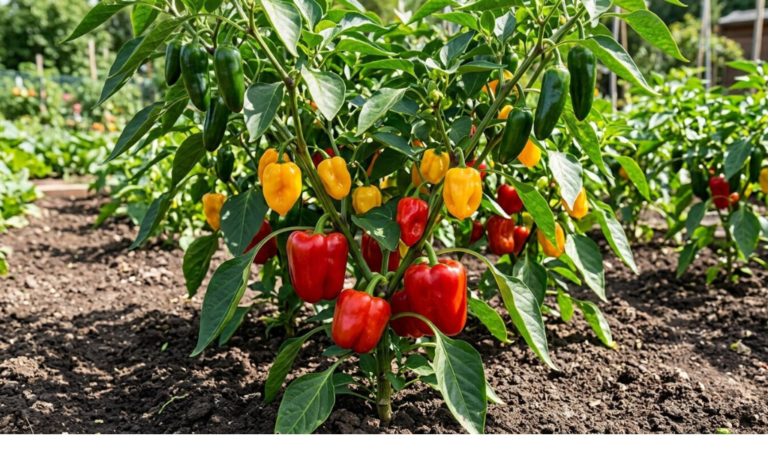
Pepper plants, from sweet bell peppers to fiery habaneros, can grow anywhere from 1.5 feet to over 4 feet tall. As they mature and fill up with fruit, their stems face real pressure. A stem that seemed perfectly upright in June can start leaning badly by August. Add a gust of wind or a heavy rainstorm, and that lean turns into a snap.
This guide walks you through everything you need to know about supporting pepper plants: why it matters, which pepper varieties need it most, what types of support work best, and how to stake pepper plants without damaging them. By the end, you’ll have a clear plan to keep your plants healthy from seedling to harvest.
Why Pepper Plants Need Support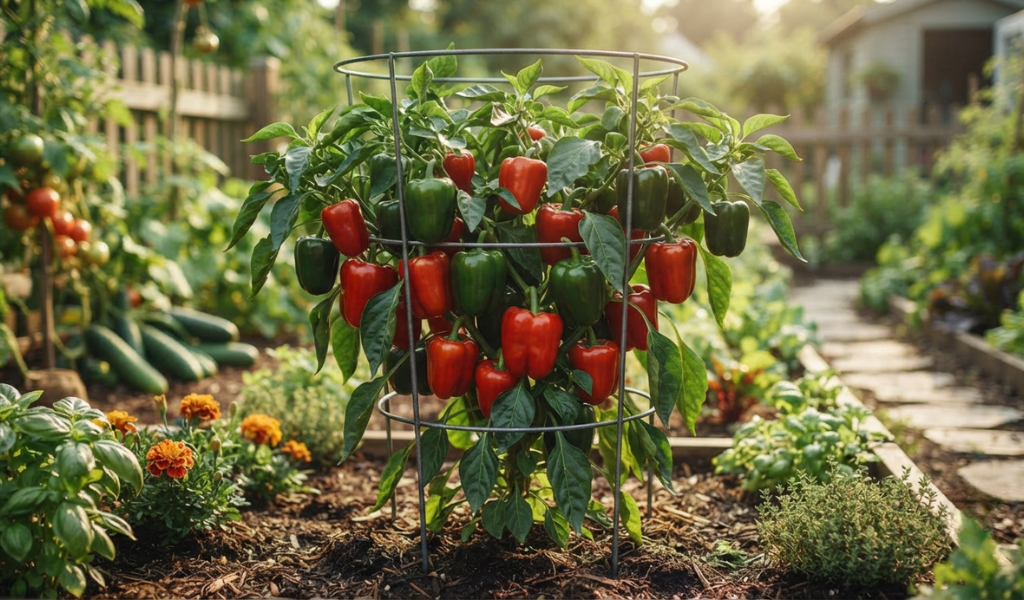
Pepper plants are naturally upright growers, but that doesn’t mean they’re self-sufficient. As a plant matures and produces fruit, the weight distribution along its branches changes significantly. The main stem, which starts out thin and flexible, has to carry the load of multiple peppers ripening at the same time. For many varieties, that’s simply too much without some outside help.
There’s also the issue of structure. Most pepper plants develop a branching habit, meaning the plant splits into multiple stems above the first node on the main stem. Each of those branches grows outward and upward, and when fruit starts forming at the tips, those branches can sag or even break. A sturdy support system keeps all of those branches in the right position.
Wind is another major factor. Even a modest breeze can rock an unsupported plant repeatedly, stressing the root systems and loosening the plant’s grip in the soil. High winds can knock a plant completely over, especially if it’s already top-heavy with fruit. Staking also reduces this movement, giving the plant stability while it focuses its energy on producing peppers.
Finally, airflow matters. When plants are allowed to flop or sprawl, leaves bunch together, trapping moisture and creating conditions where disease can spread. Keeping your plants upright and open improves airflow and easier harvesting becomes possible too, since you can actually see and reach the peppers.
What Happens Without Plant Support?
Skipping support might seem harmless in the early stages, but the consequences tend to show up right when your plants are at their most productive.
Without a stake or cage, a pepper plant that gets heavy with fruit will start to lean. That lean puts stress on the main stem, and if it continues unchecked, the stem can split or snap at a weak point. Once a main stem breaks, that section of the plant is essentially lost.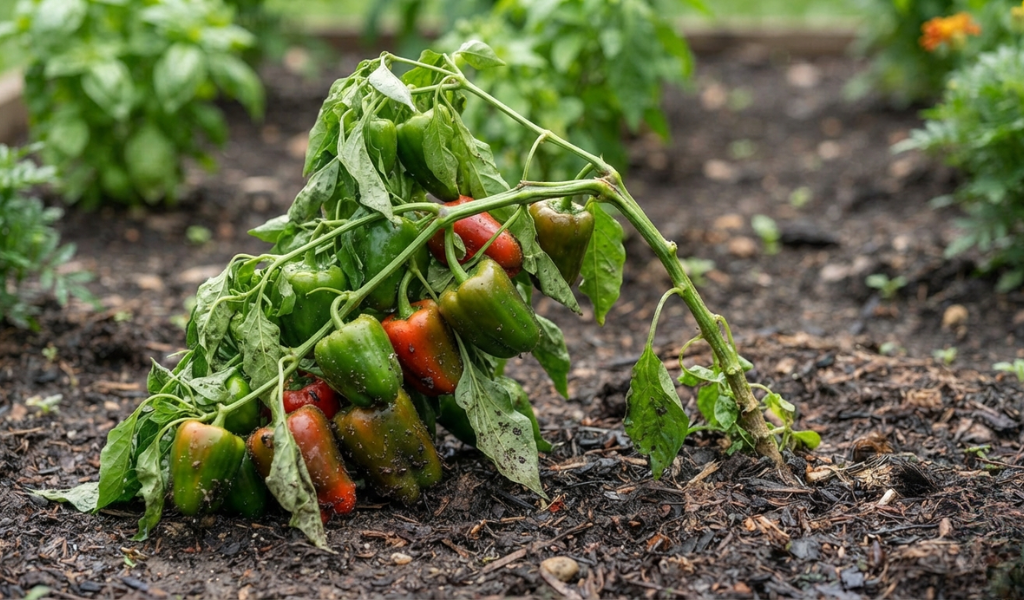
Branches suffer too. Hanging branches loaded with fruit can break off entirely, and any peppers on those branches will stop developing. Even if the branch doesn’t break, peppers that hang too low can touch the soil, which increases the risk of rot and pest damage.
Plants that are leaning or sprawling also compete with themselves for sunlight. Leaves that end up shaded by other parts of the plant can’t photosynthesize effectively, which slows growth and reduces yields. For a gardener putting months of effort into a crop, this kind of preventable loss is genuinely frustrating.
Do Pepper Plants Need Support and Which Pepper Varieties Need Support?
Not every pepper plant has the same needs. The variety you’re growing plays a big role in determining how much support is required.
Bell Peppers
Bell peppers are one of the most common reasons gardeners start thinking about support. These plants grow bushy and wide, and their fruits are large and dense. A single bell pepper can weigh several ounces, and a plant loaded with multiple fruits can become seriously top-heavy. Bell pepper plants almost always benefit from a sturdy stake or cage, particularly once fruit starts developing. Without it, the plant will lean and branches will droop.
Chili and Hot Pepper Varieties
Hot pepper varieties vary quite a bit in their support needs. Capsicum annuum varieties like jalapeños and cayennes tend to grow moderately tall and can develop a reasonable amount of fruit weight. Capsicum chinense varieties, which include habaneros and ghost peppers, tend to grow larger and bushier, and the plants can hold an impressive number of fruits at once. Both groups benefit from support, though the exact type depends on how large and bushy the specific variety gets.
Smaller hot peppers like Thai chilies often grow in compact, upright clusters and may not need much support at all. The key is to observe how your plant is growing and act before leaning becomes a problem.
Compact vs. Tall Pepper Plants
Compact varieties and container-grown peppers often manage well with minimal support, though even a simple stake can be helpful if the plant starts leaning. Taller pepper plants, especially those reaching 3 to 4 feet or more, almost always need support. Larger pepper plants grown in garden beds are particularly vulnerable in windy spots, and a support system should be considered standard practice for these varieties.
Types of Support for Pepper Plants
There are several practical options for supporting pepper plants, each with its own strengths. Choosing the right one depends on the size of your plant, how it grows, and what you have available.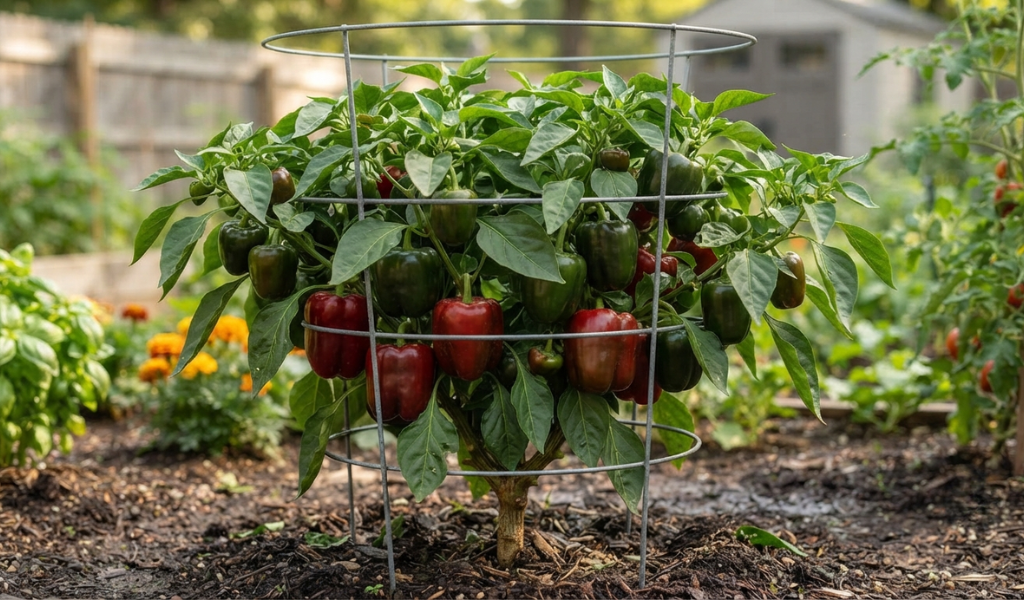
Garden Stakes
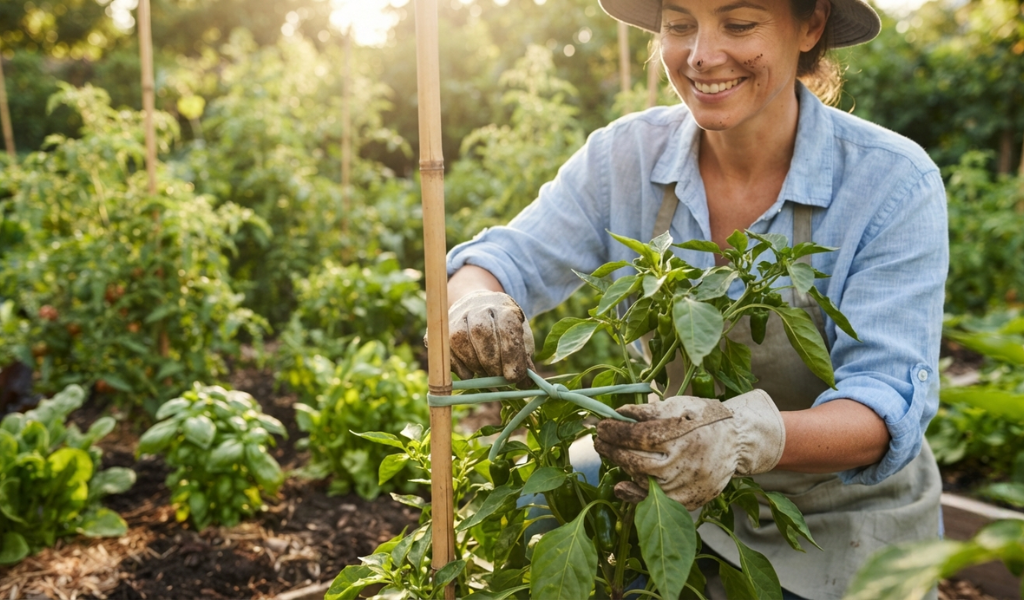
Garden stakes are the most straightforward option. You push the stake into the ground near the base of the plant and then tie the main stem to the stake using twine or soft plant ties. Stakes come in a variety of sizes and thicknesses, so you can choose one appropriate for your plant’s expected height. Bamboo stakes are a popular choice because they’re lightweight, affordable, and strong enough for most pepper varieties. Metal stakes offer more durability and are worth considering for larger pepper plants or exposed garden beds. Traditional stakes work well for upright varieties where the goal is mainly to keep the main stem straight and stable.
Tomato Cages
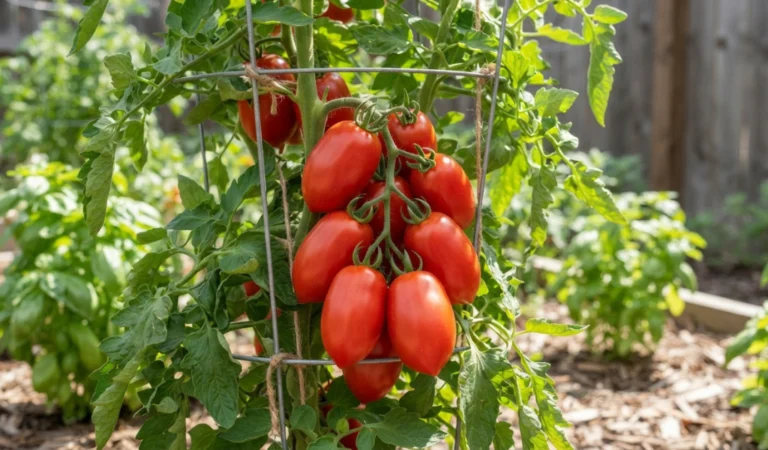
Tomato cages are a practical choice for bushy pepper plants, especially bell peppers and other spreading varieties. Instead of tying individual stems, the cage provides circular supports that the plant can grow into naturally. Use tomato cages that are sturdy enough to hold the plant’s weight, since flimsy cages can tip over once a plant gets heavy with fruit. Many gardeners find that a cage that can be tethered to a stake or fence post provides even better stability in windy conditions. For especially bushy varieties or types that spread outward, a cage often does a better job than a single stake.
Trellises
A trellis works best for pepper plants grown in rows, particularly in raised beds or structured garden layouts. You can run twine horizontally between posts and weave or tie branches as they grow, giving each section of the plant its own line of support. A trellis provides strong support for multiple plants at once and makes harvesting easy since you can walk along the row and see exactly where the peppers are. It also keeps the plants nicely spaced, which improves airflow throughout the bed.
When Should You Support Pepper Plants?
Timing matters. Getting support in place at the right stage prevents damage rather than trying to fix it after the fact.
Seedling Stage
For most growers, staking isn’t necessary immediately after transplanting a seedling, but it’s smart to insert your stake at this point anyway. Pushing a stake into the soil near a young, newly transplanted pepper plant is much easier than trying to do it later without disturbing the root systems. Insert your stake within a few inches of the base, and push it deep enough to be stable — at least 6 inches into the soil for smaller plants, more for larger stakes. You can leave it loosely tied or untied at this stage.
Before Flowering
Once a pepper plant starts to develop flower buds, support becomes more urgent. This is when the plant is preparing to carry fruit and its stems are under increasing load. Securing the plant before flowers appear ensures the plant is stable during the critical fruit-set period, when the flowers turn into developing peppers. If you haven’t added support yet, now is the time.
During Fruit Development
As fruit develops and grows toward ripeness, the weight on your plant increases steadily. Check your ties and make sure the stake is still firmly in the ground. Some plants may need additional support at this stage, particularly if they’re loaded with heavy fruits or if branches have grown in unexpected directions. Adding a secondary tie higher up the main stem or supporting a specific heavy branch with an extra stake can make a real difference.
How to Stake Pepper Plants Correctly
Staking is simple, but doing it right protects your plants rather than harming them.
Choosing the Right Stake
Match your stake to your plant. A small, compact pepper plant can be supported with a thin bamboo stake. A tall, heavy bell pepper plant needs something more substantial a thicker bamboo stake or a metal stake. The stake should be sturdy enough that it doesn’t bend or wobble when you push it into the ground. For plants expected to reach 3 to 4 feet, the stake should be at least 4 to 5 feet long so that enough of it goes underground to hold firm. Always check that your stake is sturdy before tying anything to it.
Tying Plants Without Damage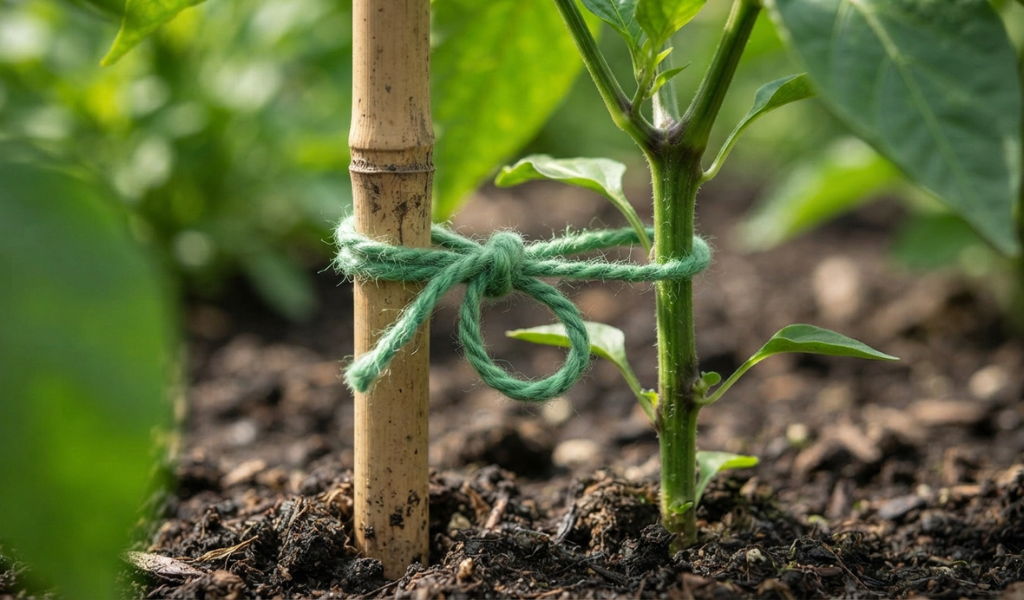
The most common mistake when using stakes is tying the plant too tightly. Soft twine, old pantyhose, or purpose-made plastic-coated plant ties all work well because they have some give. Avoid using wire or anything rigid that can cut into the stem. When you secure the plant, tie the twine around the stake first, then loop it around the stem loosely, leaving enough space that the stem can still thicken as it grows. Tether the plant to the stake at the node on the main stem rather than in the middle of an internode to minimize the risk of damage. Always allow for growth when tying what fits comfortably today may be too tight in two weeks.
Common Mistakes to Avoid
Even experienced gardeners make some predictable mistakes when it comes to supporting pepper plants. Knowing what to watch for saves a lot of frustration.
Supporting Too Late
The most common error is waiting until a plant is already leaning or has already snapped before adding support. By that point, some damage is often unavoidable. A stem that has been stressed by leaning repeatedly may be weakened even after it’s straightened and tied. Getting support in place early, ideally at transplant time or just before flowering, is always the better approach. It’s far easier to prevent a problem than to recover from one.
Tying Too Tightly
A tight tie cuts off circulation and can girdle a stem, essentially strangling it. The damage doesn’t always show up immediately, but over time a too-tight tie will cause the stem above the tie point to weaken and the plant’s growth to slow. Check your ties every couple of weeks, especially during the peak growing season when stems thicken quickly. Loosen or replace any tie that looks like it’s pressing into the stem.
Benefits of Supporting Pepper Plants
Taking the time to support your pepper plants pays off in ways that are easy to see by harvest time.
Healthier Plants
Supported plants simply grow better. When a pepper plant doesn’t have to struggle against gravity or recover from wind damage, it can put more energy into root development, leaf growth, and fruit production. Upright plants with good airflow are also less prone to fungal diseases, which tend to thrive in humid, crowded conditions. The root systems of a well-supported plant are less disturbed by wind movement, which helps the plant absorb water and nutrients more effectively.
Bigger Harvests
The practical payoff is a better yield. Plants that are supported produce more fruit because they’re healthier overall, and more of that fruit reaches full ripeness without falling off or rotting. Airflow and easier harvesting go hand in hand when you can see and reach your peppers clearly, you’re more likely to pick them at the right stage of ripeness, which also encourages the plant to keep producing. Many gardeners report noticeably larger harvests simply from making staking a regular part of their pepper growing routine.
Give Your Pepper Plants the Support They Deserve
Most pepper plants need support, and the ones that don’t still benefit from it. A simple stake, a tomato cage, or a well-set-up trellis can be the difference between a plant that struggles through the season and one that produces abundantly until frost.
Start early, choose the right type of support for your variety, and tie your plants loosely so they can grow without restriction. Check on them regularly as the season progresses and add extra support when a plant gets especially heavy with fruit. These aren’t complicated steps, but they consistently produce better results.
Good pepper growing comes down to paying attention to what your plants need at each stage. Support is one of the most reliable tools a gardener has, and it costs very little in time or money relative to what it returns.
Frequently Asked Questions
What is the best support for pepper plants?
The best support depends on the variety. For bushy types like bell peppers, a tomato cage works very well because it supports the whole plant without requiring individual ties. For tall, upright varieties, a sturdy bamboo or metal stake tied with soft twine is usually the most effective option. In row gardens, a trellis with horizontal twine lines can support multiple plants efficiently.
Do pepper plants need stakes or cages?
Both work well, but they suit different plants. Stakes are better for upright varieties with a clear main stem, while cages suit bushier plants that branch out in multiple directions. Some growers use a combination, placing a stake inside a cage for extra stability when growing large or especially top-heavy pepper plants.
What are common pepper growing mistakes?
The most common mistakes include waiting too long to add support, tying plants too tightly, planting in poor-draining soil, watering inconsistently, and not thinning fruit early in the season to reduce weight on branches. Supporting plants late and tying them too tightly are particularly easy mistakes to make and can damage the very plants you’re trying to protect.
Can I use a tomato cage for staking peppers?
Yes. Tomato cages are one of the most practical support options for pepper plants, particularly bell peppers and other spreading varieties. Choose a cage that is tall and sturdy enough for your specific plant, and consider tethering it to a stake if you’re growing in a windy location. Standard circular wire cages available at most garden centers work well for most pepper varieties.
Do I need to stake bell pepper plants?
In most cases, yes. Bell pepper plants produce large, heavy fruits and tend to grow with wide, spreading branches. Without a stake or cage, they commonly lean, develop drooping branches, and may snap under the weight of fruit. Staking or caging bell pepper plants early in the season is one of the most reliable ways to protect your crop.
Do pepper plants need a trellis?
A trellis is optional but useful, particularly for growers with multiple plants in a row. It provides good support across a wide area and keeps plants well-spaced for airflow. If you’re only growing a few plants, stakes or cages are usually simpler and more practical than setting up a trellis system.
When should I start supporting my pepper plants?
The earlier the better. Inserting a stake at transplant time is ideal because it avoids disturbing the root systems later. At minimum, get support in place before flowering begins, which is when the plant starts preparing to carry the weight of developing fruit.