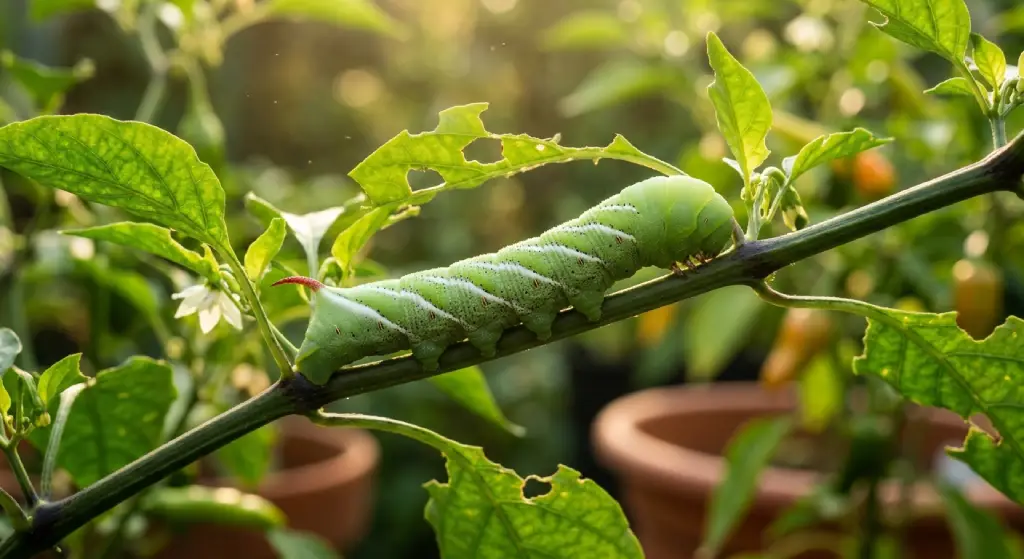
Pepper Hornworm Identification, Damage, and Natural Eradication Guide
Pepper Hornworm: How to Identify, Control, and Prevent Leaf Loss
You walk out to your garden with your morning coffee and something feels off. The hot pepper plant that looked full yesterday now has bare stems poking out of it. Half the leaves are gone and you can’t see a single bug. Chances are a pepper hornworm is sitting right in front of you, and it is very good at hiding.
This big green caterpillar can strip a plant in a few days. If you have spent weeks on pepper growing, from starting seeds to pinching pepper seedlings so they grow bushy and strong, it hurts to watch one pest undo that work. The good news is that hornworms are easy to beat once you know what to look for. This guide walks you through how to spot them, how to find them, how to get rid of them, and how to keep them from coming back.
What Is a Pepper Hornworm? (Identification & Life Cycle)
A pepper hornworm is the larva of a large sphinx moth. The word “hornworm” comes from the sharp looking horn on its back end. It looks scary but it is harmless to touch. It cannot sting or bite you. Its only goal is to eat leaves and grow fat.
These caterpillars are not picky about one plant. They feed on nightshade family crops, which means tomato, eggplant, potato, and peppers are all on the menu. A nightshade plant is what we call a host plant, because it gives the moth a safe place to lay eggs and gives the young larva food as soon as it hatches. Hot pepper plants are not their first pick, but when tomatoes run low or the pepper plants are close by, they will happily move over.
Tobacco Hornworm vs. Tomato Hornworm on Peppers
Two species cause most of the trouble in home gardens. People often call both of them by the same name, but there are small differences that help you tell them apart.
The tobacco hornworm has seven white diagonal stripes along each side of its body. Its horn is usually bright red or orange. The tomato hornworm has eight V shaped white marks on each side, and its horn is dark blue or black. Both are pale to bright green and both can reach about 4 inches long when fully grown.
Both tomato and tobacco hornworms love pepper leaves, though tobacco hornworms are a bit more common on peppers than on tomatoes. Don’t worry too much about which one you have. The control steps are the same for both. What matters is that you learn to spot that green body and chunky shape against a green plant.
The moths look alike too. Adults are gray brown with orange yellow spots along the sides of the belly. They fly at dusk and feed on flower nectar with a long tongue. Many people mistake them for hummingbirds because they hover in front of blooms, which is why they are often called hummingbird moths.
The Five Instar Stages: How Fast Do They Grow?
A hornworm grows through five stages called instars. Between each stage the caterpillar sheds its skin and gets bigger.
It all begins with the eggs. A moth lays small, round, pale green eggs, usually one at a time on the underside of a leaf. The eggs hatch in about four to five days. The first instar larva is tiny, only about a quarter inch long, and it is easy to miss. At this size it nibbles small holes and does very little harm.
By the third instar the caterpillar is much bigger and starts to eat far more. The last two instars are where the real damage happens. In the fourth and fifth stages a hornworm can eat more than 90 percent of everything it will consume in its entire life. That is why a plant can look fine one day and wrecked the next.
The whole larval stage lasts about three to four weeks. Then the caterpillar drops to the ground and burrows several inches into the soil. There it turns into a brown pupa, which looks a bit like a small shiny cocoon with a handle on one side. Hornworms overwinter in this pupal stage in the soil. In warm areas adults emerge in a few weeks and lay a second round of eggs. In cooler places they wait until the next spring.
In many regions the first moths show up around early July, and a second wave can arrive in late summer. Knowing this timing helps you check your plants at the right moments.
How to Spot Hornworm Damage on Pepper Plants
Spotting the damage early gives you a huge advantage. Most gardeners notice the damage long before they notice the worm, so learning the signs is the best way to catch them in time.
Stripped Leaves, Defoliated Stems, and Chewed Peppers
The first sign is usually ragged leaves with large bites taken from the edges. Younger hornworms leave small holes. Older ones eat whole leaves and sometimes just leave the bare stem behind. If the top of your plant looks naked while the lower part still has foliage, a hornworm is probably working from the top down.
The damage goes beyond leaves. When the leaves are gone, the fruit is exposed to sun and gets scalded. Hornworms also chew right into peppers, leaving scooped out spots or deep scars. Shishito and other thin walled peppers get hit hard because there is not much flesh to protect them.
One gardener I know grew a row of hot pepper plants near her tomatoes and ignored them for a long weekend. When she came back three of her five plants had lost most of their leaves, and a single worm the size of her thumb was still chewing. It happens that fast. Even one hornworm on a small plant can cause real harm. A mature plant may bounce back from a single worm but young plants may not.
Keep in mind that a few hornworms rarely cause economic damage on a large farm. But in a home garden where you only have a handful of plants, one caterpillar matters a lot.
Identifying Dark Green or Black Frass (Hornworm Droppings)
If you can’t find the worm, look for its droppings. Hornworm frass looks like small dark green or black pellets, about the size of a grain of rice, with grooves along the side. You will often find them on leaves below the feeding spot or on the soil beneath the plant.
Fresh frass is dark green and soft. Older frass turns black and dry.  If you see a pile of pellets and the leaves above are chewed, look straight up. The caterpillar is almost always close by, usually on the stem or on the underside of a leaf.
The frass is also a useful clue about size. Big droppings mean a big hornworm. Tiny pellets mean you have a younger one, and you caught it just in time.
How to Find Hidden Hornworms in Your Garden
Hornworms are masters of camouflage. Their green color blends with the leaves and their stripes look like the shadows of veins. They also hide during the day, usually under leaves and along thick stems. So finding them takes a little patience and a few tricks.
The Early Morning Inspection Method
The best time to hunt is early in the morning. Hornworms are cooler and slower then, and they are often out in the open eating before the day heats up. Take a slow walk down your rows and check each plant from the base to the top.
Start by looking for chewed leaves and fresh frass. Then follow the damage. Gently lift the leaves and check the underside where the caterpillar likes to rest. Look along the main stem too, because older hornworms often cling to it and look just like a branch. Squinting helps. Many people find that if they stop trying to see a worm and instead look for a shape that does not belong, they spot them faster.
It also helps to look for eggs. Check the undersides of leaves for tiny round pale green balls. If you find one, you can wipe it off with your finger before it ever becomes a problem.
And don’t forget to look closely at any hornworm you find. If it has small white rice shaped bumps on its back, leave it alone. That brings us to a very helpful friend that is covered later in the prevention section.
Using Blacklight UV Flashlights at Night
Here is a trick that surprises most gardeners. Hornworms glow under UV light. A cheap blacklight flashlight turns them a bright neon green in the dark, so they stand out like little glow sticks.
Wait until it is fully dark, then walk through your garden with the light pointed at your plants. The caterpillars will light up, even the ones that are well hidden under the foliage. The chlorophyll in the body and some compounds in the skin are what cause that glow. Bring a bucket along so you can remove them right away.
This method works best for older larvae. Very small ones can still hide, so combine the night check with your morning walk. If you grow a lot of peppers or tomatoes, a UV flashlight is one of the best tools you can buy for around ten dollars.
Effective Organic & Chemical Treatments
Once you find hornworms you have a few good options. For most home growers the simple methods work best, and you rarely need strong chemicals.
Hand-Picking and Soapy Water Bucket Disposal
Handpicking is the easiest and safest way to deal with them. Wear gloves if you feel squeamish. Pull the caterpillar off the stem, since it holds on tightly, and drop it right into a bucket of soapy water.  The soap breaks the surface tension so the worm sinks and drowns fast. A tablespoon of dish soap in a bucket of water is plenty.
Some gardeners feed the caterpillars to chickens, which love them. Others just drop them far from the garden. Be careful about the second option, because they can crawl back or find another plant.
Check your plants every day or two for a week after you find the first one. Hornworms rarely come alone, and the eggs that were laid at the same time will hatch over several days. Staying on top of it in the first week can save your whole crop.
One warning. Before you pick a hornworm and toss it, check its back for those white cocoons. A hornworm covered in tiny white cocoons has been parasitized by a braconid wasp.  The wasp larvae have eaten the inside of the caterpillar and are now ready to hatch. That worm is nearly done eating and will die soon. Leave it in your garden so more wasps can emerge and protect your plants next year.
Applying Bacillus thuringiensis (Bt) Biological Sprays
If you have a lot of plants or you simply can’t find the worms, Bt is a good next step. Bacillus thuringiensis is a natural soil bacteria. Look for the kurstaki type on the label, which is made for caterpillars. When a hornworm eats a leaf that was sprayed with Bt, the bacteria damage its gut. It stops eating within hours and dies in a few days.
Bt is safe for people, pets, bees, birds, and most helpful insects. It only harms caterpillars that eat treated leaves. That makes it one of the best organic pesticide choices out there. Among the insecticides available to home growers, it is also one of the gentlest.
To use it well, follow the label and spray both sides of the leaves. Do it in the evening, because sunlight breaks Bt down quickly. Bt works best on young larvae. Big fifth instar caterpillars can shrug it off for a while, so handpick those. You will need to spray again after rain, usually every five to seven days while the pests are active.
A word about harsher products. Chemical sprays like spinosad or pyrethrin based products can also kill hornworms. But they can harm bees and the predatory insects that you want in your garden, and you should only reach for them if nothing else is working. Always read the label first, and never spray open flowers. Remember that a hot pepper bloom is a stop for pollinators.
How to Prevent Hornworms: Weeds, Beneficial Insects, and Pollinators
Treatment is only half the story. A few small habits can lower your chances of seeing hornworms at all.
First, pull the weeds. Some common weeds like horsenettle and jimsonweed are in the nightshade family. Moths will happily lay eggs on them, and then the larvae move over to your peppers. Keeping the garden edges clean removes these backup host plants.
Second, till or turn the soil in fall and again in early spring. Since hornworms overwinter as pupae a few inches down, digging can bring them to the surface where birds find them or the cold kills them. Even a light turn of the soil around your pepper plants helps.
Third, attract beneficial insects. This is the most natural way to get biological control working for you. Green lacewings, lady beetles, and paper wasps all eat hornworm eggs and small larvae. Braconid wasps lay their eggs inside the caterpillar and the young wasps eat it from the inside. You can invite all of these helpers by planting flowering plants like dill, fennel, alyssum, and yarrow near your peppers. Dill is a great choice because it brings in predatory insects and the moths often lay on it, though I like to plant it nearby as a trap crop and check it often.
Fourth, think about pollinators and moths. Planting flowers that bloom through the season feeds bees and keeps predators around. It will also feed hummingbird moths, the adults of your pest, so some gardeners worry about this. A good approach is to place the flowers a few feet away from the peppers and keep scouting. The helpers you gain usually outweigh the moths you attract.
Finally, mark your calendar for mid-summer. This is when numbers often peak, and the second generation can be even bigger than the first. Check your plants twice a week from early July through late summer. Covering young plants with a light row cover until they get bigger can also block moths from laying eggs. Just remove it when the flowers open so pollinators can get in.
A small note on companion planting. Marigold and basil are popular companions, but results vary. Don’t count on them alone. A healthy mix of regular scouting, clean soil, and plenty of helpful insects works much better.
Conclusion: Protect Your Pepper Crop Before the Next Moth Arrives
A pepper hornworm looks like a big problem, but it is one you can handle. Learn to recognize the tobacco and tomato hornworm, and you will know what you are dealing with. Watch for chewed leaves and dark frass. Walk your plants in the early morning and again at night with a blacklight. Handpick what you find, use Bt when numbers climb, and leave any parasitized worm alone so the wasps can do their job.
Then build a garden that works with you. Pull the nightshade weeds, turn the soil, and plant flowers that attract beneficial insects. Those steps cost very little and pay off for years.
Go check your pepper plants today. Lift a few leaves and look for pellets on the soil. If you find a hornworm, you have already won half the battle. Share what works in your own garden with a friend who grows peppers, because every grower has dealt with this pest at least once.
Frequently Asked Questions (FAQ)
What do pepper hornworms eat besides pepper leaves?
They feed on most plants in the nightshade family. That includes tomato, eggplant, and potato. They also eat weeds like horsenettle and jimsonweed. They will chew on green fruit too, so peppers are not safe even after the leaves are gone.
Are hornworms dangerous to touch?
No. The horn looks sharp but it is soft and does not sting. You can pick one up with bare hands. Some people prefer gloves because the feet cling tightly and the worm can thrash around a bit.
How long does it take a hornworm to ruin a pepper plant?
A single large caterpillar can eat most of a small plant in two to four days. Young plants are at higher risk. Larger plants may survive one worm, but several can strip a plant quickly.
What should I do if I find a hornworm with white rice-like cocoons on its back?
Leave it where it is. Those are braconid wasp cocoons. The caterpillar is already parasitized and will stop eating soon. The new wasps will go on to attack other hornworms in your garden.
Is Bt safe to use on peppers I plan to eat?
Yes. Bt is approved for organic gardening and you can harvest fruit shortly after spraying. Check the label for the exact waiting time. Wash your peppers before you eat them like you would any garden produce.
When do hornworms show up in the garden?
In many areas the first moths appear in early July and the larvae follow a week or two later. A second wave often arrives in late summer. Warm regions may see them earlier. Start checking your plants as soon as the weather warms up.
Can pinching pepper seedlings help against hornworms?
Pinching pepper seedlings makes plants bushier and stronger, which helps them handle some leaf loss. It does not stop hornworms though. You still need to scout often and remove any caterpillars you find.