How to get rid of spider mites on pepper plants : DIY Remedies and Spray Protocols
How to Spot, Treat, and Prevent Spider Mites on Pepper Plants
You walk out to the garden with your morning coffee and something looks off. The leaves on your favorite pepper plant have tiny pale dots, a few are turning yellow, and there is a thin silky web near the growing tips. Spider mites on pepper plants are easy to miss until the damage is already clear, and by then the pest has often been busy for weeks.
The good news is that you can win this fight. Spider mites are tiny, but they are not unbeatable. With the right steps you can get rid of pests like these without wrecking your harvest or your soil. This guide walks you through what they are, how to spot the damage early, which treatments actually work, and how to keep them from coming back. If your plants are drooping and you are searching for how to fix pepper plants wilting, mites are a common cause that many growers overlook, so keep reading before you reach for the watering can again.
What Are Spider Mites and Why Do They Attack Pepper Plants?
Spider mites are not insects. They are arachnids, which puts them in the same family as spiders and ticks. That is where the name comes from. They have eight legs, no wings, and a body so small that you can barely see it with your eyes alone. An adult is about the size of a grain of sand, usually around one fiftieth of an inch long. Most people only notice them when they spot the damage or the fine web they spin.
These eight-legged pests feed by poking into leaf cells and sucking out the sap. A pepper plant has soft, thin leaves packed with juice, which makes it an easy meal. A common pepper plant like a bell, jalapeño, or cayenne can host thousands of mites in a short time if nobody checks. Chili plants grown for hot sauce are just as likely to get hit, and a heavy infestation can kill a young plant when it is left alone.
Understanding the Two-Spotted Spider Mite Life Cycle
The two-spotted spider mite is the one you will meet most often in a vegetable garden. The adults can look yellow, green, or reddish brown, and you can sometimes see two dark spots on the sides of the body. They live on the undersides of leaves where they are safe from wind and sun.
The life cycle has four stages: egg, larva, nymph, and adult. The eggs are round, clear, and almost too small to see. In warm weather they hatch in about three days. The young mites then move through their stages quickly, and in hot conditions a full cycle can finish in a week or less. A single female can lay a hundred or more eggs in her short life.
That speed is the real problem. Mites reproduce so fast that a handful on Monday can turn into a crowd by the following weekend. A gardener who waits a week to see if things improve usually finds the problem has doubled or tripled. This is why early action matters more than the exact product you pick.
Why Hot, Dry Conditions Trigger Spider Mite Outbreaks
Spider mites thrive in hot, dry weather. When temperatures climb above 85 degrees and the air has little moisture, their eggs hatch faster and the adults lay more. Rain and humidity slow them down, which is why outbreaks often show up in the middle of a dry summer or on plants kept indoors near a heater or sunny window.
Dust makes things worse. Dusty leaves along a dirt road or a gravel path can protect mites from their natural enemies and sprays. Plants under stress from heat or too little water also become easier targets. A pepper plant that is already struggling gives off signals that mites seem to love.
Greenhouse growers know this problem well. A warm and still greenhouse is almost a perfect home for mites, and the same goes for a sunny porch or a grow tent without enough airflow. If you grow peppers in any of these spaces, check often and keep the air moving.
How to Identify Spider Mite Damage on Pepper Leaves
Spider mite damage starts small and builds up. The first sign is usually tiny pale or yellow dots on the upper side of the leaf. Gardeners call this stippling. Each dot is a spot where a mite poked through and drank the sap. At first you may think it is a nutrient issue or sunburn.
As the problem grows, the dots join together and the whole leaf turns dull, bronze, or yellow. Leaves may curl, dry out, and drop. Growing tips often look stunted, and new growth can twist or stay small. In bad cases you will see fine webbing between leaves and stems, especially near the tips and in the joints where branches split. The web is not there to catch food. It protects the mites and helps them move across the plant.
Here are a few simple ways to confirm what you are looking at.
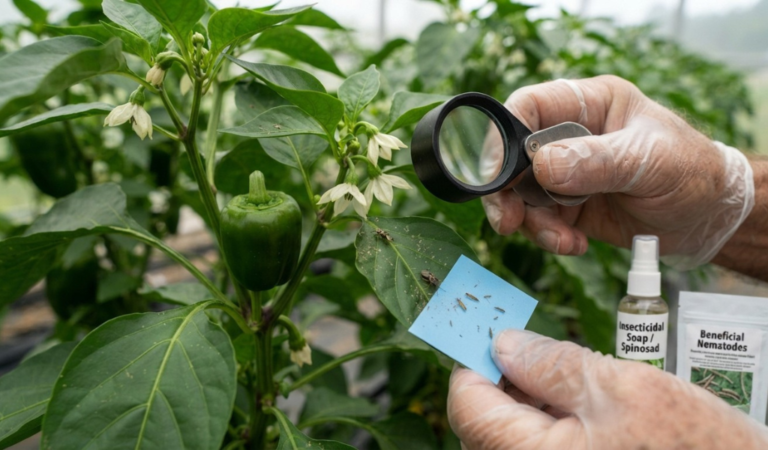
First, flip a leaf over. Most mites live on the undersides of leaves, so check there before anywhere else. Use a magnifying glass or the zoom on your phone camera. You should see tiny moving specks.  Some may look like pale dots and others darker.
Second, try the paper test. Hold a white sheet of paper under a branch and tap it firmly. If tiny specks fall and start crawling, you have mites. If they smear red when you press them, that is a good sign too.
Third, check for other sap-sucking pests. Aphid colonies, whitefly, and thrips can cause leaf curl and yellow spots as well. Aphids are slightly bigger, soft bodied, and cluster on new growth. Whiteflies fly up in a small cloud when you shake the plant. Thrips leave silvery streaks. Sorting out which pest you have helps you pick the right fix.
One more thing about wilting. Many gardeners think drooping leaves mean the plant needs water, so they soak it. But if the root zone is fine, the wilting may come from mites draining the plant. Check the soil first. If it is moist and the leaves still look weak with fine dots underneath, treat for mites instead of watering more.
A short real story shows how fast this can go. A reader in a dry climate grew eight cayenne plants on a sunny patio. In late July the lower leaves got speckled and a little crispy. She figured it was heat and kept watering. By mid August the webs had spread across half the plants, and three lost most of their leaves. Had she flipped one leaf over two weeks earlier, a simple water rinse could have solved it.
Organic and DIY Treatments for Spider Mites on Peppers
For light and medium problems, you do not need harsh products. Home treatments work well if you start early and stay consistent. The trick is to repeat them, because sprays rarely reach the eggs. Plan on treating the plants every five to seven days for at least two to three weeks so you catch each new batch as it hatches.
Before any spray, remove the worst leaves. Cut off heavily infested leaves and discard them in a sealed bag in the trash. Do not toss them on the compost pile where mites can survive and move back to your garden.
High-Pressure Water Rinses
This is the cheapest and fastest first step. Use a garden hose with a spray nozzle and rinse the plant firmly, paying extra attention to the undersides of leaves. The water knocks mites off, breaks their webs, and washes away dust. It does not hurt the plant as long as you are not blasting young seedlings at full force.
Do this early in the morning so the leaves can dry in the sun. Wet leaves in the evening can invite fungus. Repeat every two or three days for the first week, then weekly. For peppers in pots, move them to a sink, a shower, or a spot in the yard so you can spray from all sides without soaking the soil too much.
Water alone will not wipe out an infestation, but it can cut the numbers a lot and slow their spread. It also helps you see how bad things really are once the webs are gone.
Neem Oil and Insecticidal Soap Sprays
Neem oil and insecticidal soap are the two most popular organic sprays for spider mites on pepper plants, and both work by direct contact. That means the spray has to touch the mite, so coverage matters. Spray the tops and bottoms of the leaves, the stems, and the growing tips.
For insecticidal soap, follow the label on a store bought bottle. If you prefer a homemade version, mix about one teaspoon of mild liquid dish soap into a quart of water in a clean spray bottle. Pick a plain soap without bleach or degreasers. Always test on a few leaves first and wait a day to see if the plant reacts. Soap can burn leaves in strong sun or when the mix is too strong.
Neem oil works a bit differently. It smothers mites and can disrupt how they feed and grow. Mix it as the label says, shake well, and spray again every week. Neem oil can also help with aphids and other soft bodied pests, so it earns its place in the garden shed.
A few tips make these sprays safer and stronger. Spray early in the morning or at dusk when it is cooler and the sun is low. Avoid spraying when the plant is stressed by drought or when the temperature is above 90 degrees. Never spray open flowers if you can avoid it, since you may harm bees. And always rinse your harvest before eating.
Biological Control: Introducing Beneficial Predatory Mites
If you like the idea of letting nature do the work, beneficial insects are a smart choice. Spider mites have plenty of natural enemies, and some of them are easy to buy or attract.
Predatory mites are the best known. Species like Phytoseiulus persimilis and Neoseiulus californicus eat spider mites at every stage. You can order them online, and they usually arrive in a small bottle or sachet that you shake or hang on your plants. They work best in greenhouses, tunnels, and indoors where they can stay put. Release them early, when mite numbers are still low, so the predators have enough food to settle in. They need some humidity, so a very dry spot may need an occasional light mist.
Ladybugs help too. Certain small black ladybugs, often called spider mite destroyers, eat spider mites by the hundreds. The common orange and red ladybugs prefer aphids but will eat mites when they have to. Minute pirate bugs, lacewing larvae, and some tiny beetles also eat spider mites, and a healthy garden often has all of them.
You can attract ladybugs and other helpers by planting small flowers such as alyssum, dill, cilantro, and yarrow near your peppers. These plants give them nectar and a place to hide. Skip broad spectrum pesticides when you can, because they kill the good bugs along with the bad ones. A garden full of beneficial insects tends to solve many problems on its own over time.
Be realistic about timing. Predators are slow compared to a spray. Use them for steady control or after you have knocked the numbers down with water and soap. They are not a rescue for a plant that is already covered in webs.
Chemical Treatments for Severe Outbreaks
Sometimes the problem is just too big. If your plants are covered in webs, dropping leaves, and the home treatments are not working after two or three rounds, a miticide may be your next step. Think of it as a last resort, not the first move.
Several products are made for spider mites and are labeled for vegetables. Ingredients such as abamectin and bifenazate are common examples. Always check that the product is approved for peppers and read the label closely. Pay attention to the waiting time before harvest, the mixing rate, and any safety gear you need.
Be careful with general garden sprays. Many of them kill ladybugs and predatory mites, which can make spider mites rebound even worse. Some products also cause mite populations to explode a few weeks later because the natural enemies are gone. A fast looking kill can backfire.
Spider mites also build up resistance quickly. If you use the same chemical again and again, it stops working. If you need more than one round, switch to a product with a different active ingredient the next time. Your local garden center or extension office can help you choose.
If one plant is far gone, it may be wiser to pull it out and discard it. Seal it in a bag before moving it so mites do not fall onto nearby plants. Saving a plant that is nearly dead can cost you time and put the rest of your garden at risk.
How to Prevent Spider Mites from Returning to Your Garden
Prevention is easier than treatment. The goal is to make your garden less friendly to mites and more friendly to their enemies. Here is what works.
Check your plants every few days. Make it a habit when you water. Flip a few leaves over and scan for dots, webs, or tiny specks. Catching a mite problem in week one saves you from a lot of work later.
Keep plants well watered and healthy. Peppers that get steady moisture handle heat better and attract fewer pests. Mulch around the base to hold water in the soil. If you grow indoors or in a greenhouse, mist plants regularly and keep air moving with a small fan. Mites do not like wet leaves or breezy air.
Wash dust off the leaves with a quick rinse now and then. Do this early in the morning during dry spells.
Be careful when you fertilize. Fertilizing pepper plants with too much nitrogen creates soft and lush growth that mites and aphids love. Use a balanced feed and follow the label. Slow release and compost based foods are usually gentler.
Quarantine new plants. Any new pepper, tomato, or houseplant that comes home from a store should sit apart for a couple of weeks. Check it closely before putting it next to your other vegetable plants. Many outbreaks start with one infested plant that came in from the nursery.
Keep weeds down. Weeds often hold mites and pass them to your garden. Clear them near your pepper bed, especially during the hot months.
Encourage natural predators. Plant a few flowers for beneficial insects, avoid harsh sprays, and leave a small water dish with pebbles for them to drink from. Over time this builds a team that works for you every day.
If you move plants outside after winter indoors, do not rush. Harden them off slowly and check them first. Mites can ride along on mature plants and spread to the rest of the garden in days.
Final Thoughts: Stay Ahead of Spider Mites
Spider mites on pepper plants can look like a small problem until they are not. They love hot and dry weather, they multiply fast, and they hide on the undersides of leaves. But you have plenty of tools. Check your plants often, rinse them with water, use neem oil or insecticidal soap, and bring in beneficial insects for steady control. Save chemical sprays for serious cases and always follow the label.
Start today. Flip a few leaves on your pepper plants, grab a magnifying glass, and see what is hiding there. If you catch them early, you can protect your harvest and enjoy a full season of peppers for your favorite hot sauce. Found this helpful? Share it with a fellow gardener who might be fighting mites right now.
Frequently Asked Questions (FAQ)
What do spider mites on pepper plants look like?
They are tiny specks, often yellow, green, or reddish brown, living on the undersides of leaves. You will usually see the damage before the mites. Look for pale dots on the leaves, yellowing, and fine webs near the growing tips.
Can spider mites kill a pepper plant?
Yes. A small number will not do much, but a large infestation can strip a plant of its sap and leaves. Young plants and plants under heat stress are the most at risk. Early treatment makes a big difference.
What is the fastest way to get rid of spider mites on peppers?
Start with a strong water rinse and remove the worst leaves. Then follow up with insecticidal soap or neem oil, covering the undersides of leaves well. Repeat every five to seven days for a few weeks to catch new hatchlings.
Is dish soap safe for pepper plants?
Mild dish soap mixed well with water can work, but test it on a few leaves first. Use about one teaspoon per quart and avoid products with bleach or strong degreasers. Spray in the morning or evening, not in hot sun.
Are spider mites the same as aphids?
No. Both are sap-sucking pests, but aphids are insects and spider mites are arachnids. Aphids are larger, soft bodied, and cluster on new growth. Spider mites are much smaller and leave stippling and webs.
Can I still eat peppers from a plant that had spider mites?
Yes, in most cases. The mites feed on leaves, not fruit. Wash your peppers well. If you used a chemical product, check the label for the waiting time before harvest.
Will ladybugs eat spider mites?
Some do. Small black ladybugs called spider mite destroyers eat them readily, and other ladybugs will help when other food is scarce. Planting flowers nearby can bring them to your garden.